
PostHog's 7 Best Billboards (and why they work)
 Isaac WareUpdated July 30, 20268 min read
"PostHog's competition for attention is not with other boring B2B SaaS companies. It's with the internet as a whole. Memes. TikTok. HackerNews. We bring a consumer mindset to a B2B context."
Read that again, because it explains everything below. If you think you compete with other analytics vendors, you make a billboard that says "Powerful Product Analytics for Modern Teams" and nobody sees it. If you think you compete with the entire internet, you make one that says "PRODUCT ENGINEERS CAN'T RESIST ME" and put a shirtless hedgehog on it.
Here are seven of the best, and what each one is actually borrowing.
1. "Injured by high SaaS prices?"
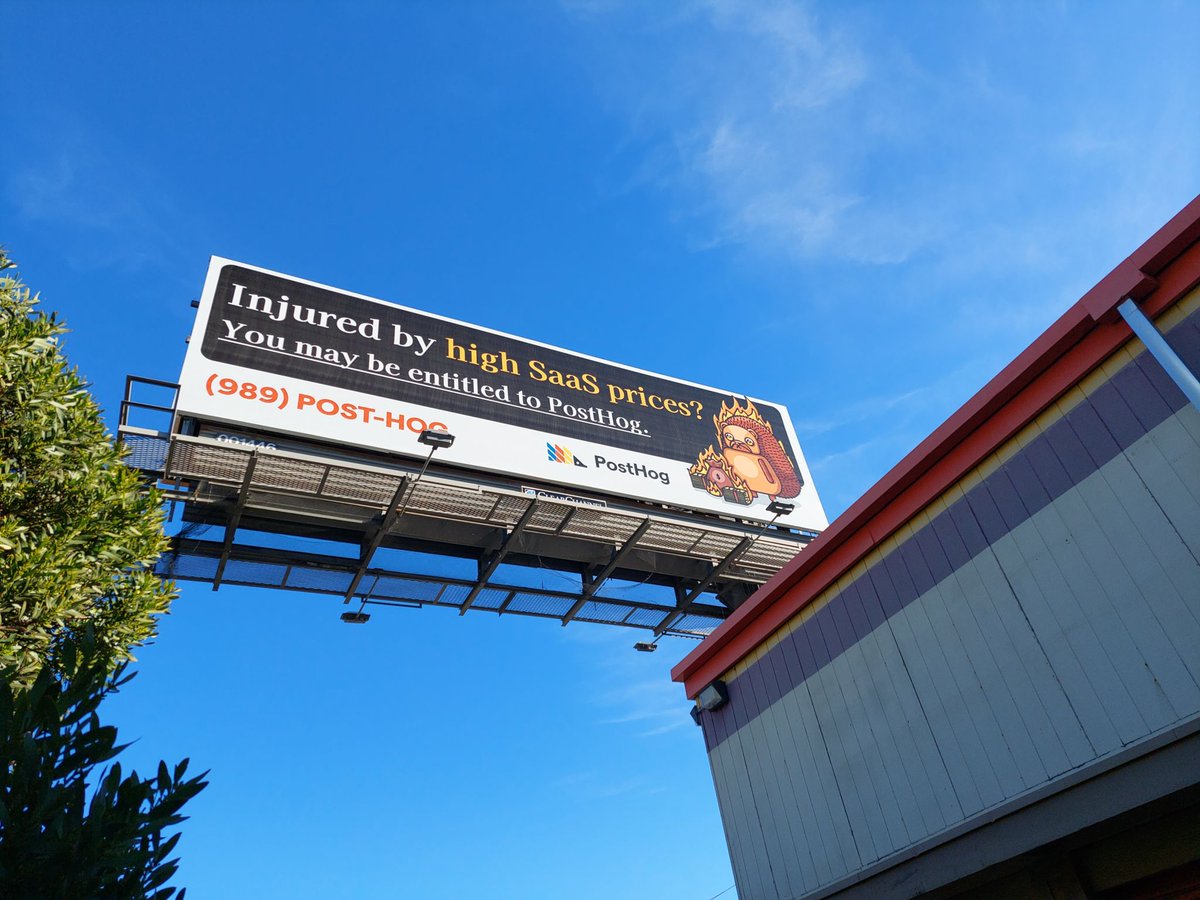
The format it steals: the personal injury attorney billboard.
Black bar, yellow highlight on the key phrase, an underlined promise of compensation, and a vanity phone number. (989) POST-HOG. There is a hedgehog in a barrister's wig on fire.
This is the single most recognisable roadside format in America, and it is one nobody in B2B software had touched. The joke works before you know what PostHog sells, which is the whole test. A driver has about two seconds, and "you may be entitled to" is a phrase that finishes itself in your head.
The vanity number is the detail that makes it complete. Nobody expects a developer tools company to have a 1-800 number gag, and committing to the bit all the way down to the phone number is what separates a parody from a reference.
2. "Were you subjected to a B2B SaaS sales call in 2024?"
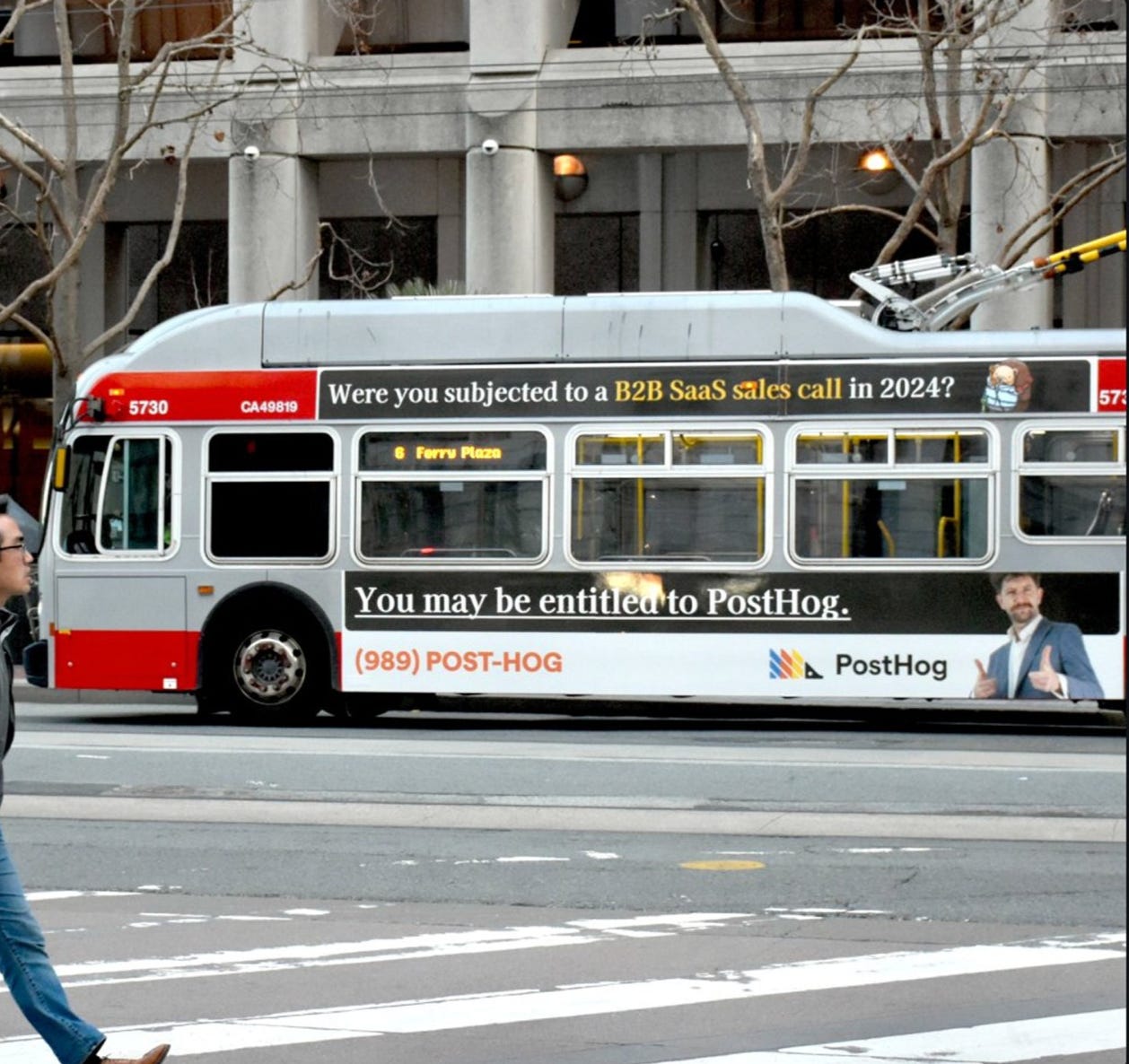
The format it steals: the class action lawsuit ad.
The second half of the same campaign, running on the side of a San Francisco Muni bus with a stock-photo lawyer giving a double thumbs up.
Two things worth noticing. First, the campaign has a universe rather than a single execution, so each new placement is a new joke inside a format people already recognised from the last one. That is how a bit compounds instead of wearing out.
Second, it picks a villain everyone in the audience already resents. a shared experience. Every product engineer in that city has sat through a discovery call they did not want, and the ad is on their side about it. Transit was the fastest-growing out-of-home advertising format two years running, and this is a good demonstration of why: the bus goes where the buyers are, repeatedly, all day.
3. "Product engineers can't resist me"
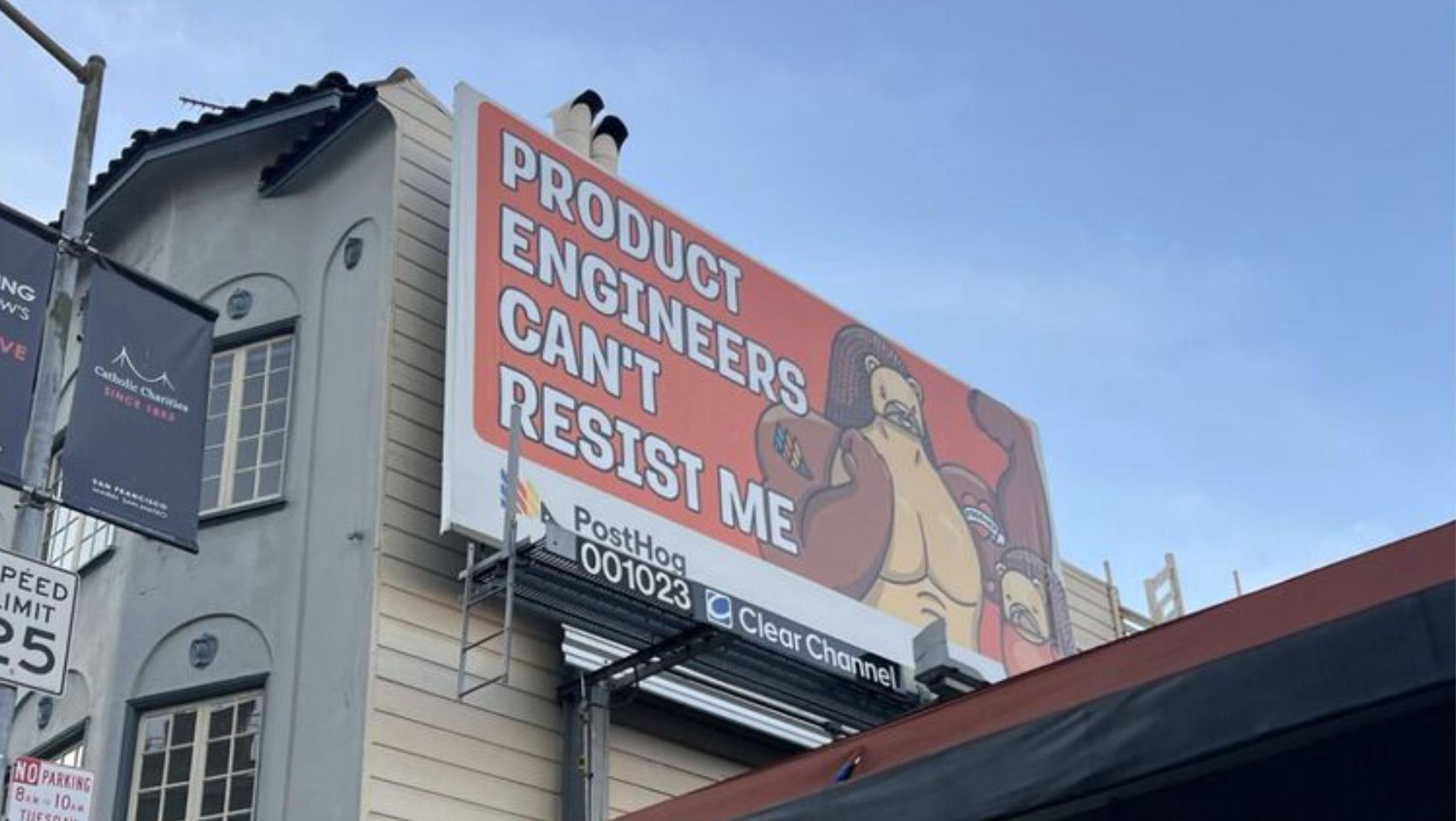
The format it steals: the thirst trap.
Enormous condensed type, hot orange background, and a hedgehog with visible biceps and a moustache doing a come-hither pose.
The line does something clever that most B2B copy will not risk. It names the audience out loud. "Product engineers" is right there in the headline, which means every product engineer who sees it knows it is for them and everybody else correctly ignores it. That is qualification work done in three words, and it is the same move Rippling made by naming HR, IT, and Finance on its street furniture.
It also has zero product information. No feature, no benefit, no URL beyond the logo. PostHog is explicit that these are not signup drivers, and this is what that looks like when a team genuinely means it.
4. "Still jumping on a quick call with sales?"
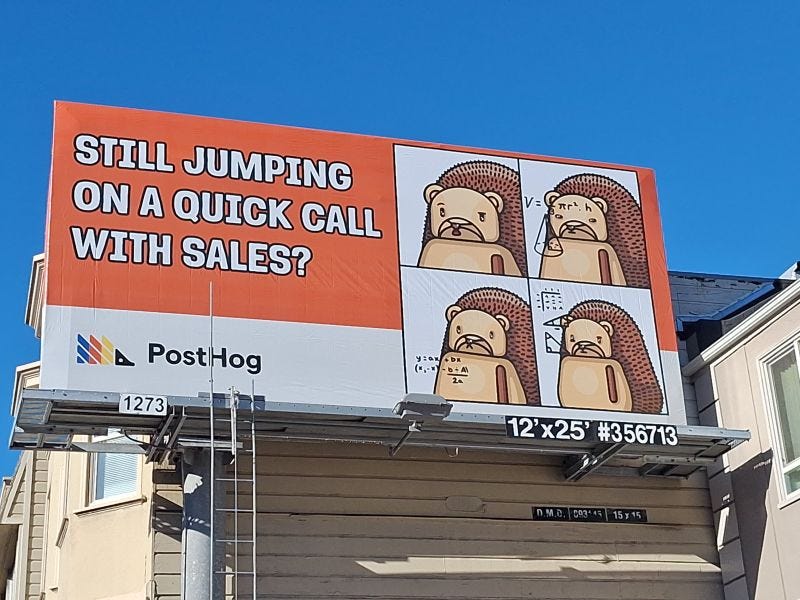
The format it steals: the four-panel reaction meme.
A hedgehog surrounded by increasingly desperate whiteboard equations, laid out in a grid that anyone who has spent time online recognises immediately as a meme template rather than an advert.
The copy is a competitive attack that never names a competitor. Everyone selling developer tools with opaque enterprise pricing is the target, and the ad lets the reader fill in which vendor annoyed them most recently. That is more effective than naming one, because the reader supplies their own grievance.
Putting a meme format on a billboard is the clearest expression of the consumer-mindset idea. The format belongs to Twitter and Reddit. Renting a physical structure to display it is the joke.
5. "Tastes better than data spaghetti"
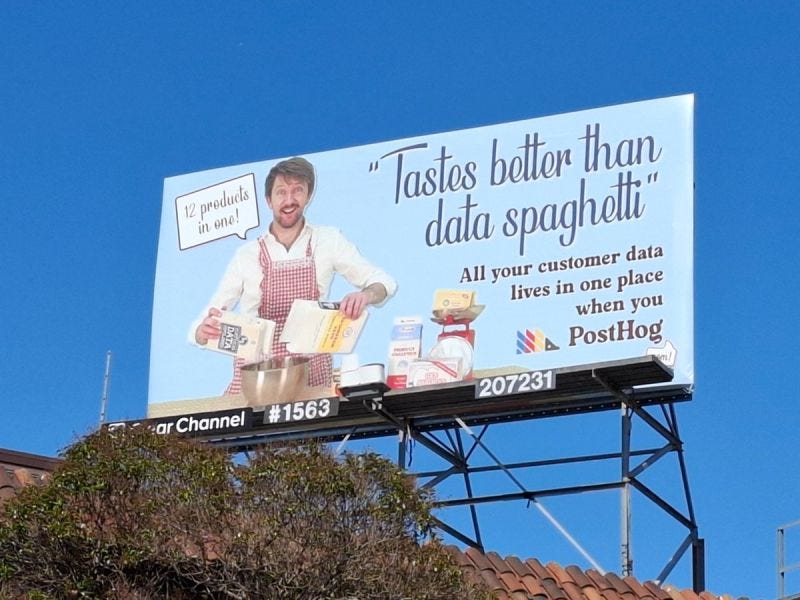
The format it steals: the cooking show and the recipe ad.
A cheerful man in a checked apron tipping boxes of PostHog products into a mixing bowl, with a speech bubble reading "12 products in one!"
This is the only one on the list doing real product work. "Data spaghetti" names a genuine pain, the mess of stitching together analytics, session replay, feature flags and the rest across six vendors, and the visual argues the solution in one glance. Twelve boxes, one bowl.
It is also the most legible from a distance, which matters more than teams expect. The image carries the message even if you never read the copy, and that is the actual requirement for anything at highway speed.
6. "Feature flags: an engineer's bread and butter"
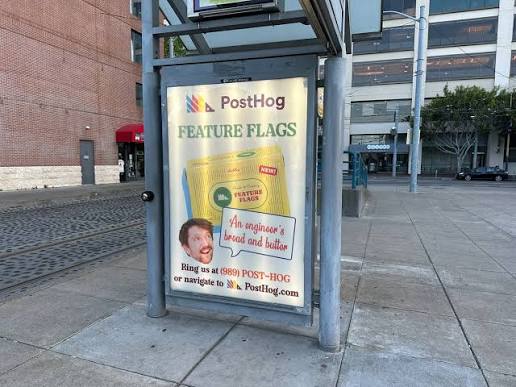
The format it steals: mid-century grocery packaging.
A transit shelter poster designed as a box of crackers, complete with a "NEW!" starburst, a hand-lettered banner, and a beaming vintage spokesman.
The pun does double duty. Bread and butter means both a staple food and the thing you rely on for a living, so the visual and the meaning land at once. That is tighter writing than it looks.
Placement matters here in a way it does not on the highway ones. A transit shelter is read by someone standing still and bored, so it can carry more detail than a bulletin, and this one uses that room for a phone number and a URL. The team clearly understood the difference between formats rather than sizing one creative up and down.
7. "'Hammer' Hawkins: fastest error logs in the west"
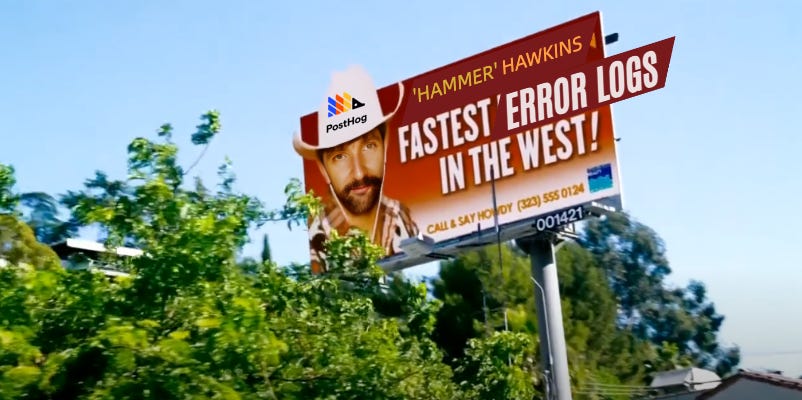
The format it steals: the local TV commercial. The used car lot, the discount furniture warehouse, the personal injury guy's cousin.
A man in a white cowboy hat, a nickname in quotation marks, an exclamation mark, and an invitation to call and say howdy.
What makes this work is the specificity of the reference. "Hammer" Hawkins is not a generic cowboy, he is the guy from the 2am ad break in a mid-size American city, and anyone who grew up with that recognises the exact register. Nailing a niche format precisely beats gesturing at a broad one, because the people who recognise it feel seen.
It is also, like the others, cheerfully unhelpful about what PostHog does. Fastest error logs in the west is not a claim anyone will verify. It is a vibe.
What actually makes these work
Four things, and PostHog states three of them in its own guidance.
They compete with the internet, not with software companies. Every format on this list is borrowed from outside B2B. Injury law, memes, grocery packaging, local TV. If your reference set is other vendors' billboards, you will produce another vendor's billboard.
They are not trying to get signups. The stated goal is awareness with product engineers at high growth companies. Not conversions. That single decision is what frees the creative, because the moment a billboard has to drive a signup, someone adds a URL, then a value prop, then a QR code, and you end up with a slide.
They expect most of it to fail. In PostHog's words, expect 95% of ideas to go nowhere, and of the ones you try, only some will really take off. A portfolio mindset is the only way to keep making things this strange, because any individual swing looks unjustifiable in isolation.
The bit is fully committed. A vanity phone number. A named cowboy character. A hedgehog with abs. Half-committing to a joke is what makes brand humour cringe, and the difference between these and the average attempt is that nobody at PostHog flinched.
Worth noting they run the same playbook off the billboard too, with a lemonade stand to launch a product and branded football kits sent to amateur teams with no strings attached. The out-of-home work is one surface of a consistent posture, which is why it reads as genuine rather than as a campaign.
What to steal if you are not PostHog
Pick a format from outside your category and commit to it completely. Name your audience in the headline so the right people self-select. Cut the URL and the value prop and see whether the idea still stands up, because if it needs them it was never going to work at 60mph. And do not judge one board on one quarter, because this only makes sense as a portfolio.
More boards with the costs and numbers are in the OOH advertising examples roundup, including Cluely's $375k Times Square board and Airlearn's double-meaning billboards.
If you steal one, steal this
If you steal one, steal the personal injury parody. PostHog took the most recognisable roadside format in America, one no software company had touched, and committed to it down to a (989) POST-HOG vanity number. The joke lands before you know what the product is, which is the only test that matters at 60mph.
FAQ
- Why does PostHog run billboards instead of paid ads?
- PostHog states that its competition for attention is the internet as a whole rather than other B2B SaaS companies, and that the goal is brand awareness with product engineers at high growth companies rather than signups. Billboards suit that goal because they build recognition without demanding a click.
- Do PostHog's billboards drive signups?
- That is explicitly not the objective. The company says it is not trying to get people to sign up from this work, which is why most of the boards carry no URL, no value proposition, and no QR code. The measure is awareness among a specific audience.
- What makes a good B2B billboard?
- One idea, very few words, and a reason for a stranger to photograph it. PostHog's boards borrow formats from outside software, name their audience directly, and commit fully to the joke. Anything that needs a second read to make sense does not work at driving speed.
- How much do billboards cost?
- It ranges enormously. Sidewalk-level guerrilla plays cost almost nothing, a wheatpaste campaign can run a few thousand dollars, and a Times Square placement can reach $375k for four weeks. Transit and street furniture generally cost far less than premium highway bulletins.
- Should a startup run billboards?
- Only if your buyers are geographically concentrated, you can afford enough frequency to matter, and you can tolerate spend you cannot attribute cleanly. Out-of-home builds familiarity ahead of demand rather than capturing it, so it fails against a quarterly pipeline target.