
Out-of-home advertising (OOH)
Also called: DOOH, Outdoor advertising, Billboard advertising
Out-of-home advertising is paid media placed in physical public space, including billboards, transit, airports, and elevator screens, that reaches people while they are away from home.
What is Out-of-home advertising (OOH)?
Out-of-home advertising is any paid placement in public space: billboards, bus wraps, transit shelters, airport dioramas, elevator screens. In B2B it works as a credibility and recall channel, not a lead source. Nobody scans a QR code at 65 mph. They see your name on the 101, then convert through search or a sales email six weeks later.
What is out-of-home advertising (OOH)?
Out-of-home advertising is any paid media that reaches people in physical public space. Billboards on the highway. Wraps on a bus. Posters in a subway station. Dioramas at the airport gate. The screen in the elevator that plays weather and stock tickers at you on the way to a meeting.
It splits into two buckets. Static is printed vinyl on a structure, bought for a four-week flight, uninterrupted for the whole run. Digital, called DOOH, is a screen rotating six to eight advertisers in a loop, so you get a few seconds every minute or so, with no print production and the ability to swap creative mid-campaign.
The channel is bigger and healthier than most B2B marketers assume. US OOH revenue hit a record $9.46 billion in 2025, up 3.6% year over year and marking the industry's nineteenth straight quarter of growth, according to the Out of Home Advertising Association of America. DOOH made up 36.3% of that and grew 10.5%. Transit was the fastest-growing format for the second year running, up 9.2%.
Here is the part that matters for anyone doing demand generation in B2B: OOH is not a demand capture channel and it never will be. There is no click. There is no form. There is no cookie. What a billboard does is make your name feel familiar to a buying committee that has not started shopping yet, so that when procurement finally asks for three vendors, someone in the room says yours without being able to explain why.
That is a real effect. It is also nearly impossible to attribute cleanly, which is why OOH gets killed in quarterly reviews by people who measure it against paid search.
How to run OOH without screwing it up
- Buy density, not prestige. A board is only worth what your buyers' commute is worth. The 101 corridor is the most contested stretch of tech OOH in the country for a reason, but if you sell to hospital administrators in Ohio, a 101 board is a very expensive way to advertise to your competitors' engineers. Map where your target accounts actually sit, then buy that.
- Budget for frequency or don't bother. One board for two weeks is a rounding error. The mechanism here is repetition against the same commuter, so a real buy means multiple placements across four or more weeks. If your budget only covers a single face for a fortnight, spend it somewhere else.
- Six words, one idea, giant type. A driver has roughly two seconds. Every additional clause costs you the whole message. If your creative needs a second read to make sense, it does not exist.
- Name your buyer on the board. Rippling's street furniture creative, broken down by MKT1, calls out "HR, IT, and Finance" outright. That single move does more qualification work than a clever headline, because the right person self-identifies in half a second and everyone else correctly ignores it.
- Set up a geo holdout before anything goes live. Pick two comparable metros. Buy one, skip the other. Track branded search, direct traffic, and demo requests in both, starting four weeks before launch. This is the only measurement approach that survives contact with a CFO, and it is worthless if you set it up after the vinyl is already hanging.
- No QR codes on highway inventory. Nobody is scanning anything at freeway speed. QR works on transit shelters, elevator screens, and airport placements where people are standing still and bored. On a bulletin it is decoration that ate a third of your legible space.
- Give the asset a second life. The photograph of the board is worth more impressions than the board. Sales sends it to accounts. Recruiting puts it in offer emails. Someone posts it on LinkedIn. Budget for a real photo shoot, not a phone picture taken from a moving car.
When is OOH a bad idea?
Your buyers are scattered. OOH is a geography play. If your customer base is spread evenly across forty states with no metro concentration, there is no efficient buy. You will pay for reach against people who will never be in market.
Your deal size is small. If your average contract is under about $25k, the arithmetic gets ugly fast. A $40k flight needs to influence a meaningful number of deals to return, and OOH influence is diffuse by nature. Performance channels will beat it on every unit economic you can name.
You need pipeline this quarter. OOH is a lagging lever. The gap between exposure and any measurable commercial effect is typically weeks to months. If the board asked for pipeline in ninety days, buying billboards is a way to have spent the money without having answered the question.
Nobody knows who you are yet. OOH amplifies recognition, it does not create it from zero. If a buyer sees your name and has no prior contact, no category association, and no reason to search you, the impression evaporates. Build enough of a footprint that the billboard has something to attach to first.
You cannot tolerate unattributable spend. Be honest about this before you buy, not after. If your organization requires every dollar to be traceable to a closed-won deal, OOH will lose that fight every single time, and the campaign will get cancelled in month two, which is exactly when it would have started working.
Examples of OOH in the wild
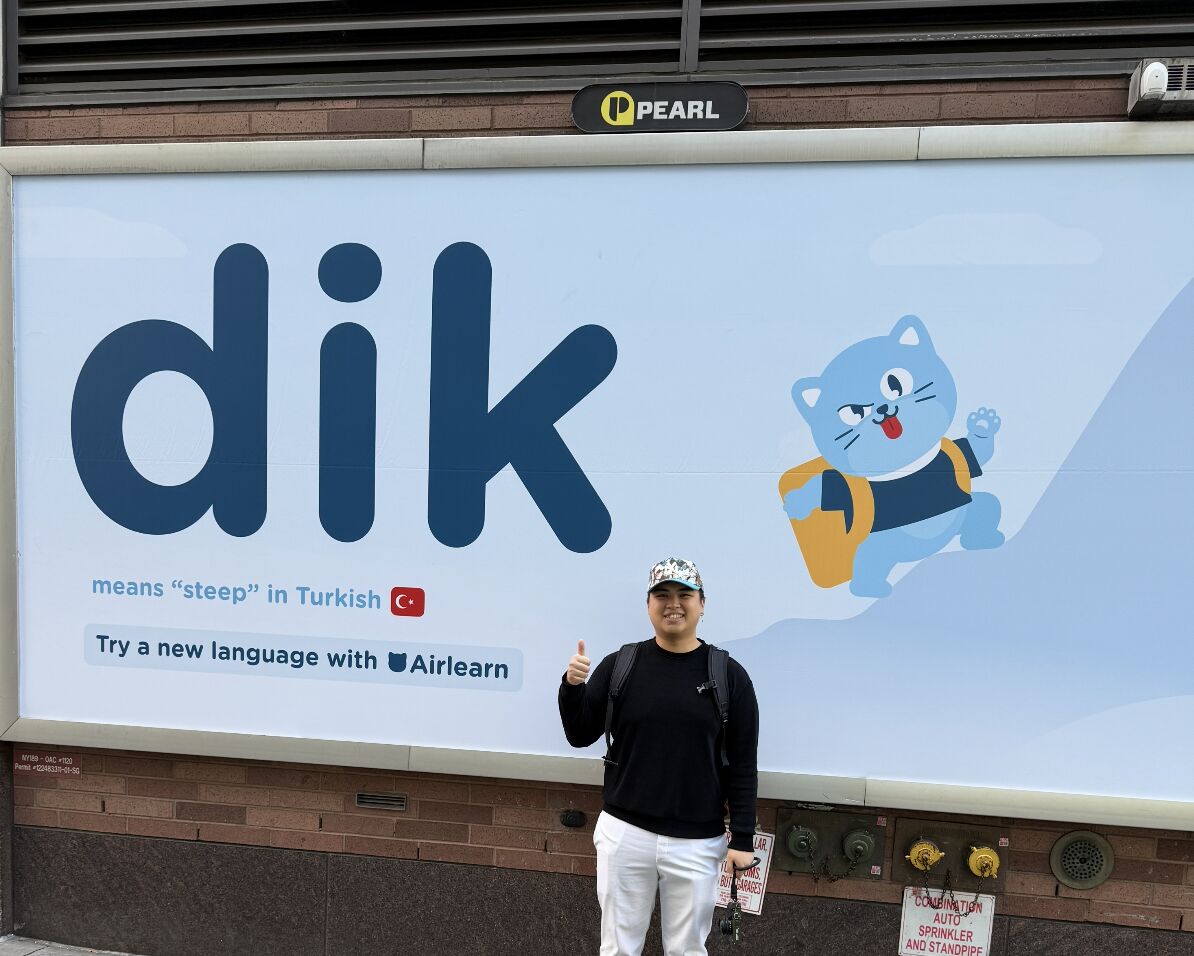
Airlearn turned a billboard into content. Double meaning billboards put innocent foreign words that read as English swear words up around New York. "Pussi" is Finnish for bag. "Kock" is Swedish for chef. The placements passed 25 million views in ten days as Reddit, Facebook, and LinkedIn carried them far past the street corner. The board stopped being an ad and became something people forwarded.
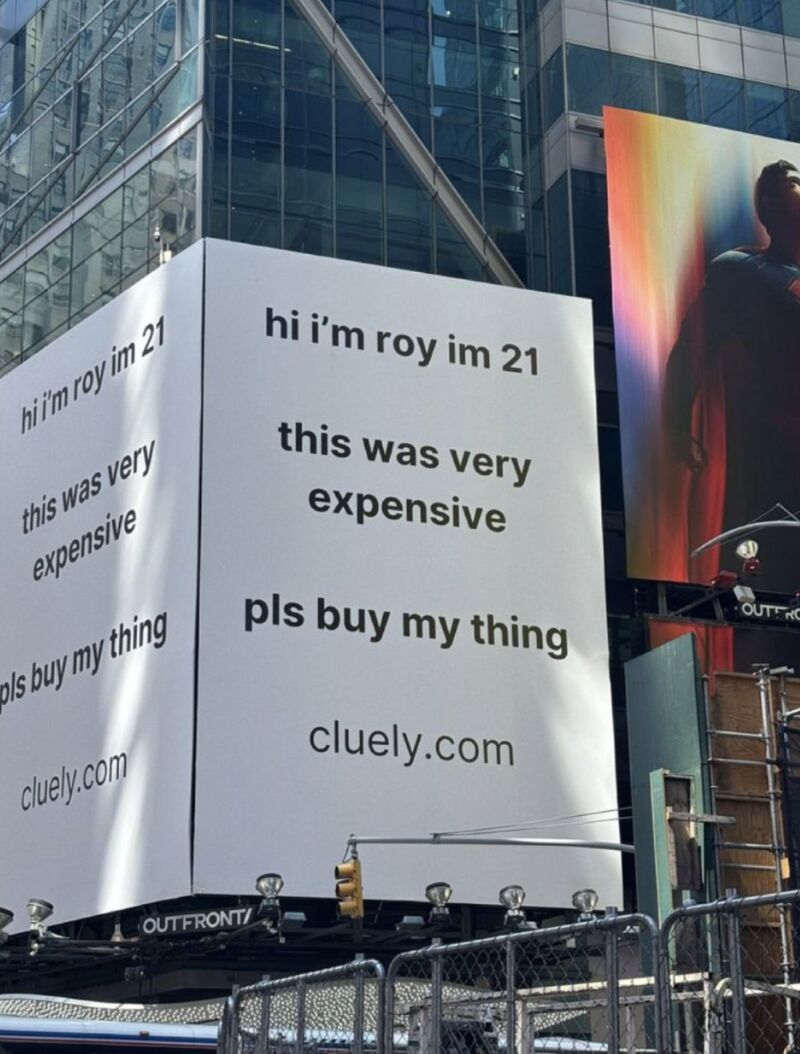
Cluely wrote a $375k board like a text message. A brutally honest Times Square billboard led with a real name, a real age, an open admission that the placement was expensive, and a flat ask to go buy the thing. Site traffic quadrupled overnight, and the board became its own meme as TikToks and parodies did the media buy's job for free.
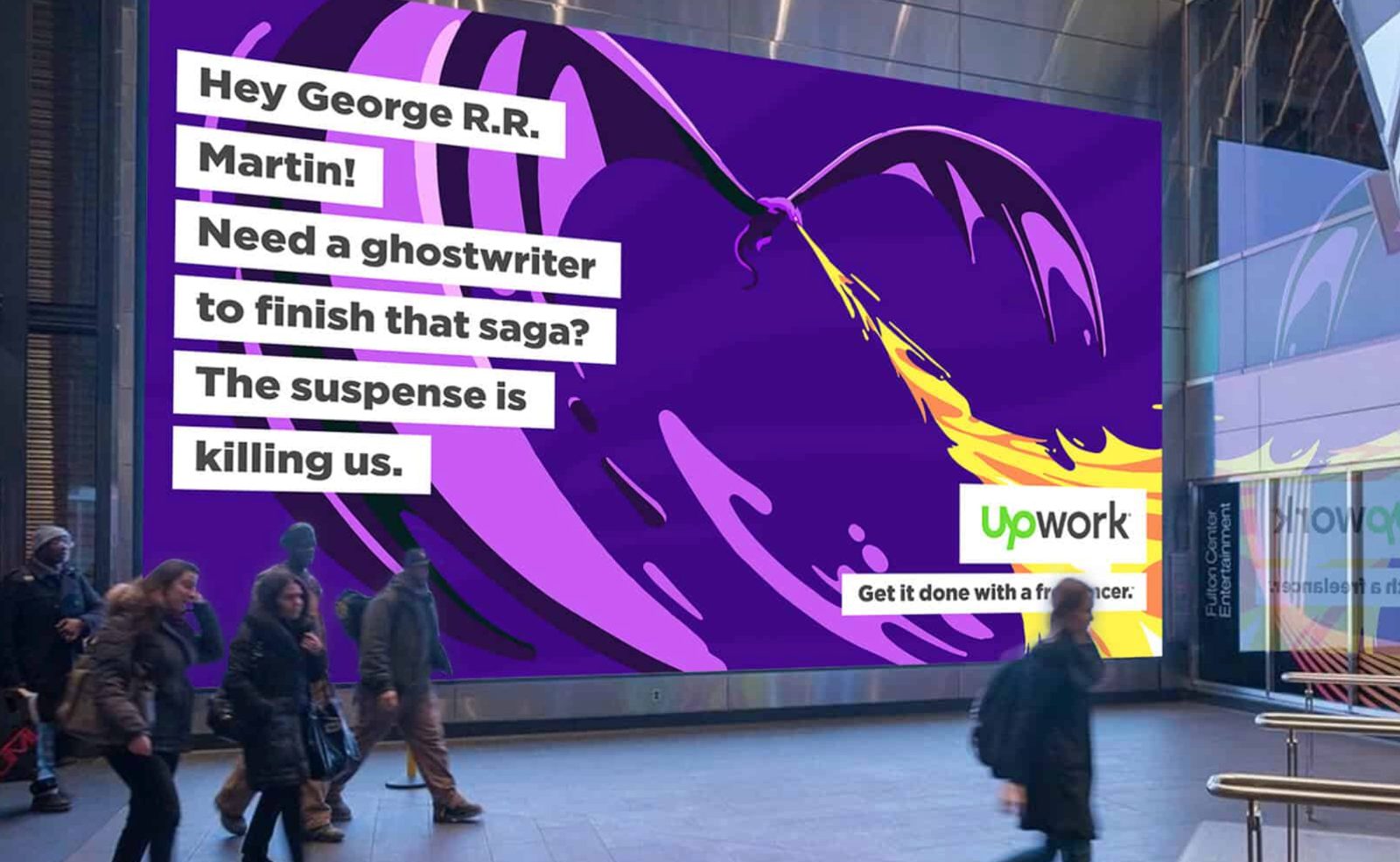
Upwork roasted famous people with unfinished business. Big type, bright color, one joke simple enough to land in the two seconds a commuter looks up, pointed at public figures with obvious loose ends and nudging them to go hire help. Upwork saw a 40% lift in registrations and a brand awareness bump across its major markets.
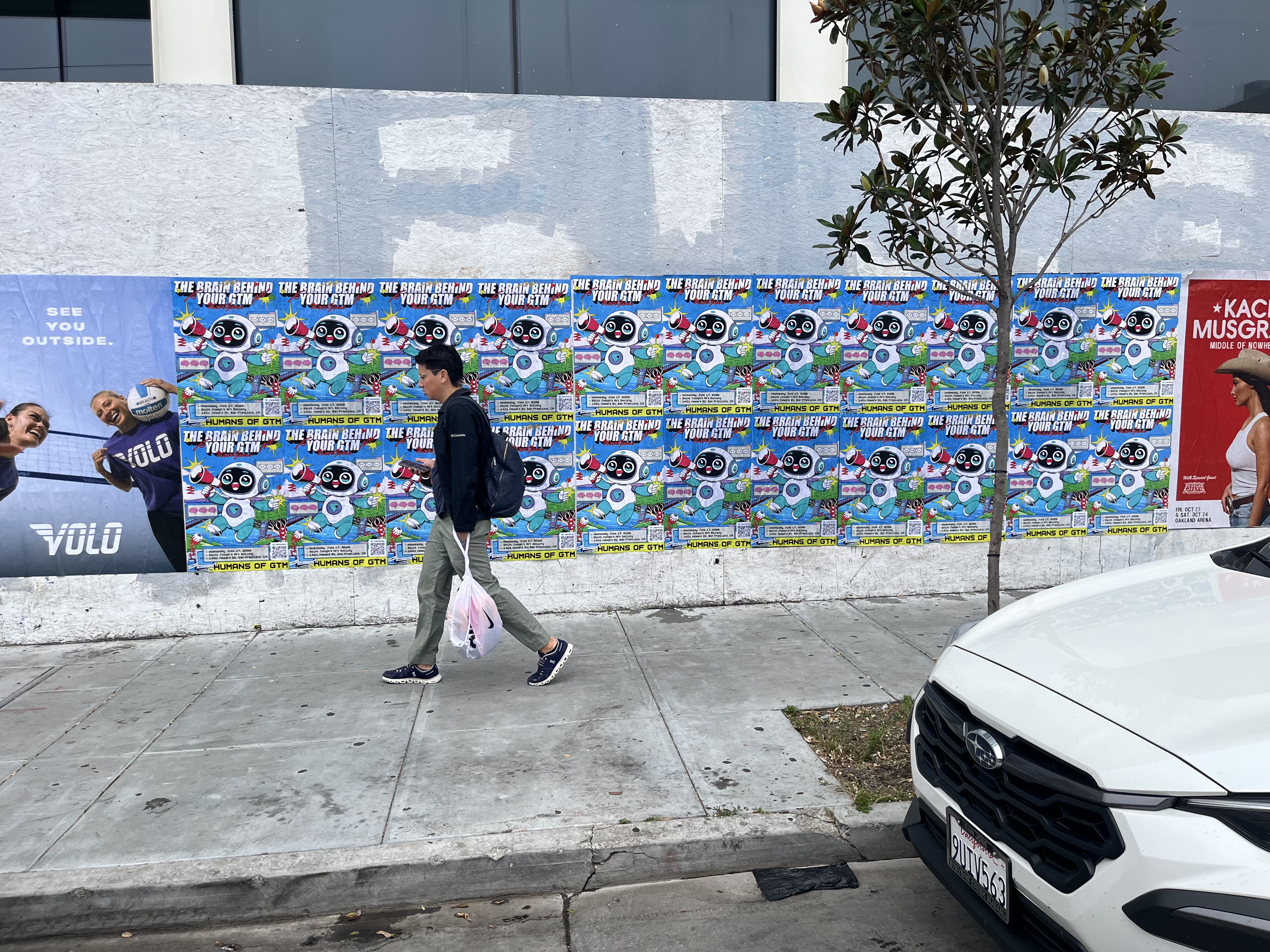
Wheatpaste instead of vinyl. Our own wheatpasting campaign in SF ran $3,500 all in, using two local pasters found on Reddit and art from a real gig poster artist. The honest result: the posters did not drive many direct registrations. What they did was set the tone for the whole campaign, which was the actual reason to run them.
Stytch, San Francisco, April 2024. Co-founder Reed McGinley-Stempel documented the buy publicly: 80 bus ads, 130 bus and transit shelter placements, eight city street billboards, and three faces on Highway 101, running for a month. The useful detail is the shape of it. Most of the budget went to high-frequency, lower-cost transit inventory, with the 101 boards acting as the prestige anchor rather than the whole campaign.
Segment's "Good morning, LA!" A billboard in San Francisco addressed Los Angeles. A billboard in Los Angeles addressed San Francisco. Austin got one addressed to Dallas, New York got one addressed to Boston, under the tagline "What good is bad data?" People who had no idea what Segment sold posted photos of it anyway, which is the entire mechanism: the confusion was the distribution.
Conference-adjacent buys. The underrated play. Rideshare wraps, transit shelters, and digital screens around a convention center during your industry's big week, bought for a fraction of a booth. Your target accounts are physically concentrated in six square blocks for four days. That is the densest your ICP will ever be, and most competitors are inside the hall paying for carpet. Pairs well with account-based marketing if you already know which logos are attending.
More of these, with the costs and the numbers, in the OOH advertising examples roundup.
Sources
- Out of Home Advertising Association of America. "Out of Home Advertising Revenue Reaches Record $9.46 Billion." March 17, 2026. https://oaaa.org/news/out-of-home-advertising-revenue-reaches-record-9-46-billion/
- AdQuick. "Billboard Advertising in San Francisco, CA." 2026. https://www.adquick.com/billboard-advertising/san-francisco-ca
- McGinley-Stempel, Reed. "When and how to run a billboard campaign." Lenny's Newsletter, 2024. https://www.lennysnewsletter.com/p/when-and-how-to-run-a-billboard-campaign
- MKT1. "How to make highway-worthy B2B billboard creative." 2026. https://newsletter.mkt1.co/p/billboard-drive-by-2
Real plays that use Out-of-home advertising (OOH)



FAQ
- How much does a billboard cost?
- In the Bay Area, AdQuick lists standard static bulletins at $4,000 to $15,000 per four-week flight, with flagship Highway 101 faces running $15,000 to $60,000 and up. Digital units run $3,500 to $12,000 per four-week share-of-voice flight. Secondary markets cost a fraction of that.
- Does OOH advertising work for B2B?
- It works for recall and credibility in markets where your buyers are geographically dense. It does not work as a direct response channel. If your success metric is attributed pipeline within the quarter, OOH will look like a failure no matter how well it performed.
- How do you measure out-of-home advertising?
- Run a geo holdout. Buy one metro, deliberately skip a comparable one, and compare branded search volume, direct traffic, and inbound demo requests across both. Set the baseline four weeks before launch. Platform-reported impressions are a reach estimate, not a result.
- What is the difference between OOH and DOOH?
- DOOH is the digital subset: screens that rotate multiple advertisers instead of a printed vinyl. It skips production costs, goes live in days, and allows creative swaps mid-flight. It accounted for 36.3% of US OOH revenue in 2025, per the OAAA.
- How long should an OOH campaign run?
- Four weeks minimum, and that is the floor rather than the target. OOH works through repeated exposure on a commute. A two-week flight buys you awareness in people who happened to drive that route twice, which is nobody.
Related terms
Account-based marketing
Account-based marketing is a B2B strategy that treats a defined list of high-value companies as individual markets, building outreach around the specific people inside them instead of chasing individual leads.
Brand awareness
Brand awareness is the extent to which buyers recognize and recall a brand when a relevant need arises, which determines whether it makes the shortlist before evaluation begins.
Ideal customer profile
An ideal customer profile is a description of the company types that get the most value from your product and are the cheapest for you to win, keep, and grow.
Demand generation
Demand generation is the marketing discipline of creating awareness and interest in a category across an entire market, then capturing that interest when buyers are ready to act.
Go-to-market strategy
A go-to-market strategy is the plan for how a company reaches and sells to a specific set of buyers, covering who you target, how you position and price the product, and which motion you sell through.